PHILANTHROPY
Chapter 7 - The Laws of Charitable Giving by Moshe Maimon
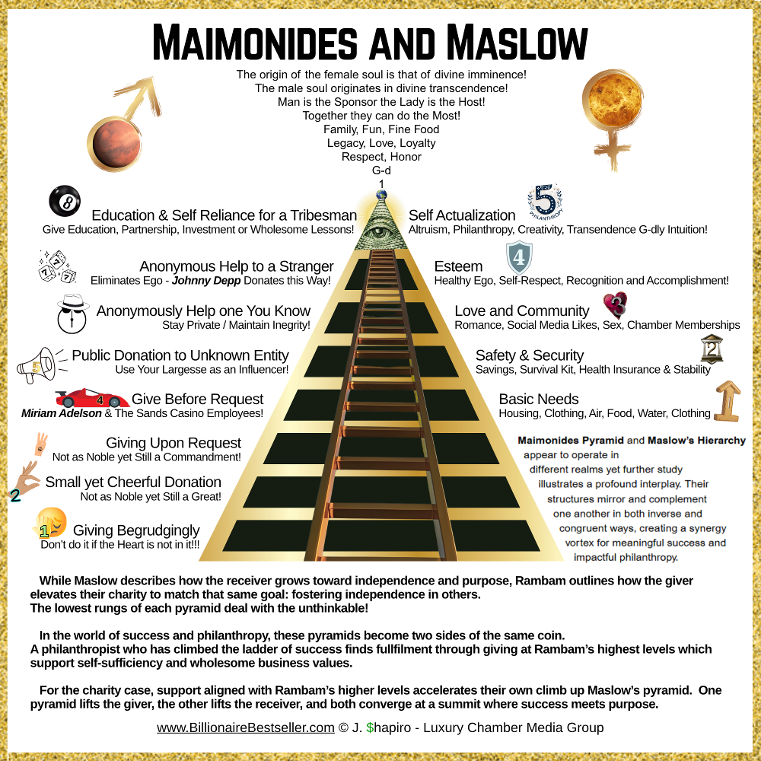
Maimonides and Maslow: Synergistic Opposites from Different Time Eras
In the rich tapestry of human thought, few figures stand as tall and distinct in their influence as Rabbi Moses ben Maimon, also known as Maimonides or the Rambam, and Abraham Maslow, the father of humanistic psychology. Though separated by centuries, geography, and worldview, both thinkers built foundational frameworks—pyramids, no less—that continue to shape human development, philanthropy, and personal growth.
Rambam, a medieval rabbi, philosopher, and physician, constructed a moral hierarchy of charitable giving, culminating in a level where the giver empowers the recipient to become self-reliant. Maslow, a 20th-century psychologist, built a hierarchy of human needs, culminating in self-actualization—a state of independence, purpose, and fulfillment. While Rambam was more conservative, grounded in Jewish law and ethics, Maslow was more free-spirited, focusing on potential, creativity, and personal liberation.
And yet, in the modern world of success and philanthropy, these seemingly opposing frameworks converge. One addresses the giver, the other the receiver—but both are essential to a fully functioning, purpose-driven society.
At the lowest rungs of both pyramids, we find the unthinkable. For Rambam, the lowest level of charity is giving begrudgingly. For Maslow, it is a state of utter deprivation—lack of food, safety, or shelter. But as one ascends each pyramid, the journey transforms. In Rambam's model, the giver becomes more conscious, more dignified in their charity, ultimately helping others help themselves. In Maslow's model, the receiver gains confidence, stability, and purpose, eventually realizing their full potential.
A philanthropist who has scaled the heights of Maslow's pyramid often finds true fulfillment by engaging in giving at Rambam's highest levels. This includes creating jobs, funding education, or providing capital for entrepreneurship. These acts do more than offer temporary relief—they cultivate independence and dignity in the recipient.
Conversely, when the charity recipient is supported in a way that aligns with Rambam’s higher principles, they are better equipped to begin their own ascent of Maslow’s pyramid. A well-timed scholarship, job training, or investment in their business doesn't just meet a need—it ignites a future.
Thus, one pyramid lifts the giver, the other lifts the receiver, and both converge at a summit where success meets purpose. In this sense, Rambam and Maslow are not opposites, but synergistic partners—guiding lights from different eras, helping modern humankind find meaning, success, and spiritual fulfillment.
Maimonides, born Moses ben Maimon in 1135 in Córdoba, Spain, lived at the crossroads of history, faith, and intellect. He emerged from a world of uncertainty to become one of the most influential thinkers in Jewish, Islamic, and Christian intellectual traditions. Known to the Jewish world as the Rambam, his life’s journey and teachings reveal a man who sought balance in all things—between reason and faith, tradition and progress, action and contemplation.
His early years were shaped by a household steeped in learning. His father, Maimon ben Joseph, was a respected scholar and judge, and young Moses grew up immersed in Jewish texts and traditions. Córdoba, during the early part of his life, was a center of culture and philosophy under relatively tolerant Muslim rule. But that peace would not last. In 1148, when Moses was still a boy, the Almohad dynasty seized control and issued a chilling ultimatum to non-Muslims: convert, flee, or die. The Maimon family chose exile. They began a long, harrowing journey through Andalusia and North Africa, wandering for years before eventually settling in Fez, Morocco.
In Fez, Maimonides continued his religious and philosophical studies, often in secret. Outwardly he may have appeared assimilated, but inwardly he held tightly to his Jewish identity. This period required resilience, strategic silence, and unwavering inner strength—qualities that would come to define him. By his twenties, he had already authored scholarly works on Jewish law and the calendar, establishing himself as a voice of precision and intellect.
Political instability continued to shadow his life, eventually prompting the Maimons to relocate once more—this time to Egypt. They settled in Fustat, part of modern-day Cairo, where the atmosphere was more tolerant and intellectually vibrant. Egypt became both refuge and crucible. Here, Maimonides endured one of the greatest tragedies of his life: the loss of his beloved younger brother David, who drowned in the Indian Ocean while on a business voyage. David had supported the family financially, and his death plunged Maimonides into a profound depression. For nearly a year, he withdrew from public life, grieving and ill. Yet out of that sorrow, he emerged with a sharpened sense of purpose.
In Egypt, Maimonides began to flourish. He became the court physician to Saladin’s royal family, treating sultans and officials by day, and healing the poor and humble by night. He refused payment from those who could not afford it, working tirelessly into the early hours of the morning. He viewed medicine not as separate from faith, but as a sacred duty. He once wrote that the physician must understand not only the body, but also the soul—a holistic view that echoes modern integrative medicine.
During this period, he penned two of the most consequential works in Jewish history. The first, Mishneh Torah, was a bold effort to systematize Jewish law. In a world of sprawling Talmudic debate and layered commentary, Maimonides offered clarity. His writing was direct, elegant, and comprehensive. Some scholars were unsettled by his audacity, arguing that he sought to supplant centuries of tradition with his own authority. But others hailed the Mishneh Torah as a lifeline—a way to access law and practice with confidence and consistency.
His second masterpiece, The Guide for the Perplexed, was aimed at those grappling with questions of faith in an age of reason. Written in Judeo-Arabic, it sought to reconcile Aristotelian logic with scriptural belief. Maimonides suggested that many biblical passages were metaphorical and that God should be understood not in human terms, but as pure intellect. These views were revolutionary and controversial. He invited criticism not only from religious literalists but from skeptics who mistrusted religious attempts at philosophical discourse. Still, the Guide inspired generations of thinkers, Jewish, Christian, and Muslim alike.
But Maimonides was more than a scholar. He was a leader, a man people turned to for guidance on ethical and legal dilemmas. His responsa—letters answering questions from communities as far away as Yemen—reveal a leader who combined intellectual rigor with compassion. He acknowledged human frailty and urged patience and mercy in both judgment and daily life.
Central to his philosophy was the idea of balance. He warned against extremes—whether in diet, behavior, or belief. Moderation was not a compromise, but a strength. He advocated for disciplined living and intellectual humility. He believed the pursuit of wisdom required constant effort, lifelong learning, and openness to questions.
This spirit of inquiry makes Maimonides strikingly relevant today, especially for those striving for excellence in the modern world. Entrepreneurs, executives, philanthropists, and educators find inspiration in his relentless pursuit of order, clarity, and impact. He believed that the pursuit of truth was not a straight line but a spiraling path—marked by missteps, recoveries, and revelations.
One of his most lasting contributions is his Eight Levels of Charity, a hierarchy that defines the purity and effectiveness of giving. The highest form of charity, he taught, is to empower a person to become self-sufficient—through a job, training, or support to start a business. This view has deeply influenced modern philanthropy, especially among those who seek systemic change rather than temporary relief. Wealthy donors, inspired by this teaching, have embraced “impact investing,” which focuses on long-term empowerment rather than immediate dependency.
He also emphasized anonymous giving, where neither donor nor recipient knows the other. This humility in giving is echoed today in practices like stealth philanthropy and anonymous endowments. For Maimonides, charity was about dignity, not display. He would have frowned upon giving for praise or legacy-building. True generosity, in his view, was measured by impact, not applause.
His teachings on community also resonate in modern business and leadership. “Start where you are,” might summarize his principle that one should first meet the needs of their local community. Many business leaders now apply this wisdom by reinvesting in their hometowns, building local infrastructure, and supporting nearby schools and enterprises before expanding globally. This localized approach, rooted in trust and familiarity, often yields deeper and more lasting results.
Even the rhythm of giving mattered to Maimonides. He encouraged consistent, sustained generosity over sporadic, dramatic gestures. He understood that just as cash flow sustains a business, regular support sustains a cause. Modern philanthropy has embraced this principle through recurring giving programs, multi-year grants, and endowment strategies that ensure stability for organizations and the people they serve.
Maimonides’ relevance stretches beyond religious circles. Billionaires such as Warren Buffett and MacKenzie Scott, through their investments in education and empowerment, reflect the Rambam’s highest ideal: helping others help themselves. His ideas have quietly influenced boardrooms, single-family offices, and foundation strategies around the globe. Entrepreneurs drawn to his teachings often cite his commitment to truth, discipline, and service as qualities that guide their lives and ventures.
For the modern goal-getter, Maimonides offers not only inspiration but instruction. His life was a model of endurance—surviving exile, heartbreak, controversy, and criticism. He worked for years on each project, crafting them with care and purpose. His medical writings reflected a commitment to evidence and ethics. His legal works brought order to confusion. His philosophy bridged seemingly opposite realms—faith and logic, body and soul, heaven and earth.
He understood that success wasn’t just about achievement—it was about intention. Wealth without wisdom, power without ethics, and charity without compassion were hollow pursuits. He urged people to ask not just “How can I win?” but “How can I help?” and “What will I leave behind?”
When Maimonides died in 1204 in Fustat, his loss was mourned across the Jewish world and beyond. According to tradition, his body was brought to Tiberias in the Land of Israel, where his tomb remains a site of pilgrimage. But his true monument is not a grave—it is the legacy of his thought. His books are still studied. His principles are still debated. His influence, still felt.
He lived at a time of war and wandering, yet spoke of peace and clarity. He saw suffering and responded with healing, questions and responded with courage. He believed that both the head and the heart had roles to play in shaping a meaningful life.
In the end, Maimonides was not merely a philosopher or doctor or rabbi. He was a master builder of systems, ethics, and bridges between the ancient and the eternal. His calm, thoughtful voice still echoes through the corridors of learning, leadership, and life. To those pursuing success today, his message is as clear as ever: Think deeply. Give wisely. Live with purpose. And never stop learning.
The 8 Levels of Philanthripic Giving by Rambam (Maimonides)
Level 8: Giving a fellow tribesman the means to support himself
(e.g., a gift, loan, partnership, or job that enables self-reliance)
This is the highest form of charity: empowering someone to no longer need charity. Today’s philanthropist can apply this principle by funding skills training, investing in startups led by underprivileged entrepreneurs, or creating jobs in underserved communities. It turns charity into empowerment and dependency into dignity—allowing the recipient to become self-sufficient and eventually a giver themselves. Richard Branson exemplifies this value buy empowering employees with a high degree of freedom to produce results almost akin to ownership results.
Level 7: Giving anonymously to an unknown recipient
(So neither donor nor recipient knows the other's identity)
This level maintains the dignity of the recipient and humility of the giver. Success-driven donors can accomplish this through anonymous funds, foundations, or intermediaries. It eliminates ego and creates trust in the giving process—ideal for those who value impact over recognition and wish to protect the spirit of generosity from personal gain. Johnny Depp is big into giving charity privately to hospitals and those in need. He does not disclose it but sometimes people behind the scenes who see the money do end up whispersing about the donations and before long its no longer a secret.
Level 6: Giving anonymously to a known recipient
(Donor knows the recipient, but recipient doesn't know the donor)
This preserves the recipient’s dignity while ensuring the donor doesn’t seek praise. In today’s world, this might look like paying someone's medical bill through a third party or leaving a scholarship in someone’s name without revealing your own. It allows the giver to retain discretion while still targeting their support toward someone they care about.
Level 5: Giving publicly to an unknown recipient
(Recipient is unknown, but donor is known)
A public gift to a broad group can still be deeply meaningful, especially if it inspires others to give. This includes sponsoring public projects, donating to disaster relief, or contributing to large-scale causes. It’s useful when leadership by example is needed, and for philanthropists who understand the power of influence in mobilizing more generosity across a community.
Level 4: Giving before being asked
(Initiating support without the recipient’s request)
Anticipating need is a powerful act of compassion and awareness. This could include stepping in to pay a struggling employee’s rent, donating to a cause just as a crisis hits, or mentoring someone who hasn’t yet realized they need it. A prime example is billionaire Miriam Adelson stepping up to the plate and paying full salaries including lost tip compensation for her 10,000 employees at The Sands Casino during the Covid pandemic era. Her generosity benefited the personnel financially and helped them maintain a certain level of EQ during trying times. These actions fostered loyalty which in turn benefited the casino in the long run. Anything less could have been a gamble with fate via lack of faith.
Level 3: Giving after being asked
(Responding to a direct request for help)
While not the most elevated form of giving, it is still worthy and generous. Responding positively to appeals—whether from friends, staff, or community leaders—builds goodwill. For business leaders and success-minded individuals, it demonstrates responsiveness and humanity, and can serve as an important gesture of support in critical moments.
Level 2: Giving less than what is needed, but doing so cheerfully
(A smaller-than-needed gift given with compassion and kindness)
Even when resources are limited, attitude matters. A small donation with a warm heart can make a big emotional difference. A successful person might not be able to fulfill every need, but their encouraging words and willingness to give what they can sets a positive tone and leaves the door open for future generosity.
Level 1: Giving begrudgingly
(A gift given unwillingly or with resentment)
This is the lowest form of giving—help given without heart. For a success-minded individual, this type of giving can be harmful. It may preserve appearances but offers little true benefit. It's better to wait until one can give with authenticity and purpose, as real philanthropy elevates both the giver and the recipient.
1. To know there is a God
Belief in a higher power anchors purpose.
→ Builds inner strength, confidence, and resilience for long-term goals.
2. Not to entertain the idea that there is any god but the Eternal
Maintain focus on what truly matters.
→ Avoids distractions and strengthens commitment to your life mission.
3. To love God
Cultivate love for a guiding force.
→ Inspires passion, consistency, and deeper motivation in one’s pursuits.
4. To fear God
Have reverence for divine order and consequences.
→ Encourages ethical decision-making and accountability.
5. To sanctify God's Name
Uphold integrity in all actions.
→ Builds a lasting, honorable personal brand.
6. Not to profane God's Name
Avoid actions that harm your moral image.
→ Protects reputation and trust in personal and business circles.
7. To worship God as He has commanded and not by other means
Stay true to authentic systems.
→ Promotes discipline and focus on proven methods rather than fads.
8. To recite the Shema twice daily
Begin and end the day with clarity.
→ Reinforces mental focus and emotional alignment every morning and night.
9. To serve God with prayer daily
Cultivate daily reflective practice.
→ Develops gratitude, intention, and strategic thinking.
10. To wear tefillin on the head
Symbolically connect thought to purpose.
→ Encourages mindfulness and higher-level strategic planning.
11. To wear tefillin on the arm
Connect action with intention.
→ Encourages purposeful daily habits that align with long-term goals.
12. To affix the mezuzah to the doorpost
Make your space a reminder of values.
→ Creates an environment of focus, discipline, and legacy thinking.
13. To recite grace after meals
Practice gratitude after success.
→ Reinforces appreciation and attracts more abundance.
14. To learn Torah and teach it
Engage in lifelong learning and mentorship.
→ Expands knowledge, influence, and leadership credibility.
15. To honor those who teach and know the Torah
Respect mentors and wise counsel.
→ Builds strong networks and accelerates growth through guidance.
16. To cleave to those who know Him
Surround yourself with ethical, visionary people.
→ Uplifts mindset and opens doors to quality opportunities.
17. To love other Jews
Cultivate unity and community support.
→ Promotes strong alliances and shared success.
18. To love converts
Welcome new people into your vision.
→ Encourages diversity, innovation, and broader perspective.
19. Not to hate fellow Jews
Let go of grudges and negativity.
→ Clears emotional space and strengthens collaboration.
20. To reprove a sinner
Offer constructive feedback when necessary.
→ Builds courage and helps improve systems and people around you.
21. To bear no hatred in your heart
Cleanse internal resentment.
→ Enhances emotional intelligence and leadership clarity.
22. To learn from past mistakes (penitence)
Reflect and improve regularly.
→ Fuels personal growth and self-mastery.
23. To pray to God
Speak your intention daily.
→ Builds clarity and attracts solutions.
24. To build a Sanctuary for God
Create sacred spaces for vision and values.
→ Encourages visionary architecture—physical or organizational.
25. To revere the Sanctuary
Respect what you build.
→ Enhances stewardship and inspires excellence.
26. To guard the Sanctuary
Protect your sacred values and mission.
→ Secures brand, boundaries, and foundational principles.
27. To Levitical services in the Sanctuary
Delegate tasks to skilled team members.
→ Optimizes performance and honors specialization.
28. To honor the Kohanim (priests)
Recognize leadership roles with humility.
→ Promotes order and respect in organizational hierarchy.
29. That the priests bless Israel
Leaders must uplift others.
→ Inspires teams, attracts loyalty and trust.
30. To wear priestly garments
Dress with purpose and role clarity.
→ Enhances executive presence and personal branding.
31. For the priests to perform their services
Execute your role with excellence.
→ Builds discipline, mastery, and consistent output.
32. For the Levites to perform their services
Everyone plays their part in greatness.
→ Strengthens collaboration and trust in team roles.
33. For the priests to wash hands and feet before entering the Sanctuary
Cleanse before important action.
→ Rituals create mindset shifts before key moments.
34. To light the Menorah daily
Bring light and clarity to your domain.
→ Symbolizes inspiration, focus, and continuity.
35. To burn incense daily
Create an atmosphere of sanctity.
→ Environment affects performance—make it uplifting.
36. To show bread before God on the Table
Acknowledge provision and abundance.
→ Honors prosperity and renews gratitude.
37. To burn the red heifer and use its ashes in ritual
Use even loss or ashes for renewal.
→ Turn setbacks into assets for future strength.
38. To immerse in a mikvah to become purified
Detox and reset.
→ Ritual resets are key for mental and emotional clarity.
39. To judge cases of damages
Uphold justice in your dealings.
→ Fairness builds trust, longevity, and brand reputation.
40. To judge cases of theft
Address and correct wrongs in business.
→ Enforces integrity and protection of assets.
41. To judge cases of injury
Handle harm with fairness and responsibility.
→ Promotes restorative culture and ethical standards.
42. To judge disputes impartially
Objectivity in leadership.
→ Leads to wise decisions and credibility.
43. To appoint judges and officers in each community
Set up systems of accountability.
→ Enables scalability and legal protection.
44. To treat litigants equally before the law
Avoid favoritism.
→ Cultivates a culture of fairness and transparency.
45. To investigate thoroughly before judgment
Research before decisions.
→ Promotes accuracy, strategy, and reduced risk.
46. To punish the guilty with the correct penalty
Apply consequences fairly.
→ Ensures justice and operational discipline.
47. To punish with lashes those who deserve it
Swift and structured discipline.
→ Keeps teams and systems on track.
48. To redeem the firstborn son
Honor tradition and legacy.
→ Builds continuity and respect for generational values.
49. To redeem firstborn donkeys
Don’t waste potential value.
→ Recover value from overlooked or odd sources.
50. To break the neck of an unredeemed donkey
Cut losses when necessary.
→ Strategic decisions include knowing when to let go.
51. To bring offerings three times a year
Consistent contribution to your higher mission.
→ Sustains momentum and long-term success habits.
52. To rejoice on festivals
Celebrate achievements regularly.
→ Motivation increases with celebration and reward.
53. To appear before God during festivals
Show up with full presence for sacred work.
→ Being fully present is essential to success and impact.
54. To observe the Sabbatical year
Rest and reboot the land/business.
→ Scheduled downtime leads to greater productivity later.
55. To cancel debts in the Sabbatical year
Let go of old burdens.
→ Frees mental and emotional bandwidth for fresh opportunities.
56. To count the years to Jubilee
Track cycles of progress.
→ Helps with goal planning and long-term vision.
57. To sound the Shofar on the Jubilee year
Announce change and renewal boldly.
→ Great leaders mark new eras with purpose and style.
58. To free slaves in the Jubilee year
Liberate what no longer serves.
→ Growth includes letting go of what holds you back.
59. To return property in Jubilee
Restore fairness and reset systems.
→ Builds community trust and economic resilience.
60. To help a fellow Jew when his means fail
Support others in crisis.
→ Builds strong bonds and circles of reciprocity.
61. To give charity
Be generous with your resources.
→ Philanthropy builds goodwill, legacy, and meaningful impact.
62. To lend to the poor
Provide opportunities, not just handouts.
→ Investing in others creates loyal allies and strong networks.
63. To give charity according to one's means
Be generous relative to your capacity.
→ Balanced generosity prevents burnout while still making a difference.
64. To give charity with a positive attitude
Uplift others with dignity.
→ A cheerful giver strengthens morale and relationships.
65. To avoid pressuring a debtor
Be patient with those who owe you.
→ Builds respect and long-term trust in business and life.
66. To return a pledge to its owner when needed
Honor agreements with empathy.
→ Strengthens your reputation for fairness and compassion.
67. To give gifts to the poor during festivals
Celebrate success by sharing it.
→ Creates joy, connection, and a cycle of abundance.
68. To leave the corners of the field for the poor
Create room in your business for community benefit.
→ Encourages sustainability and ethical capitalism.
69. To leave gleanings for the poor
Let others benefit from your overflow.
→ Reduces waste and increases shared prosperity.
70. To leave the forgotten sheaf for the poor
Don’t hoard what you won’t use.
→ Frees up space and gives others a chance to grow.
71. To leave defective clusters for the poor
Even imperfect offerings can help others.
→ Let go of perfectionism in generosity.
72. To leave unripe grapes for the poor
Share potential, not just finished success.
→ Early-stage opportunities can lift others and multiply value.
73. To bring first fruits to the Temple
Offer your first and best in gratitude.
→ Reinforces humility and abundance mindset.
74. To separate the tithe (ma'aser) from produce
Dedicate a portion to purpose.
→ Allocating resources wisely is key to scaling success.
75. To give the Levite his due
Pay those who serve your mission.
→ Fair compensation drives loyalty and long-term stability.
76. To give the priest his due (Terumah)
Honor spiritual or service leaders financially.
→ Keeps the ecosystem of support and guidance strong.
77. To separate the second tithe (ma'aser sheni)
Reserve resources for future fulfillment.
→ Encourages delayed gratification and goal setting.
78. To give the poor tithe in the third and sixth years
Plan for strategic giving.
→ Scheduled generosity builds reputation and trust.
79. To confess when bringing tithes
Acknowledge the source of your success.
→ Gratitude multiplies blessings and sharpens perspective.
80. To set aside the priest’s portion of dough (challah)
Even small things matter when offered with intention.
→ Attention to detail nurtures integrity.
81. To give the foreleg, cheeks, and stomach of slaughtered animals to the priest
Share profit from your work.
→ A reminder to give back from what you gain.
82. To give the first shearing of sheep to the priest
Dedicate initial profits to service.
→ First fruits thinking fuels spiritual and business growth.
83. To redeem the firstborn of kosher animals
Value life, legacy, and beginnings.
→ Makes you more conscious and intentional with your resources.
84. To redeem the firstborn son
Invest in legacy and future leadership.
→ Honors continuity and generational wisdom.
85. To break the neck of an unredeemed firstborn donkey
Eliminate unredeemed potential.
→ Cut losses decisively when purpose is not fulfilled.
86. To bring offerings when required
Show up with your commitment.
→ Actions speak louder than words in business and life.
87. For individuals to bring a sin offering after unintentional sin
Acknowledge and correct mistakes.
→ Humility and accountability drive personal growth.
88. For individuals to bring a guilt offering for certain transgressions
Pay the price to restore integrity.
→ Makes you more trustworthy and responsible.
89. To bring an elevation offering voluntarily
Go beyond the bare minimum.
→ Over-delivering sets you apart from the crowd.
90. To bring a peace offering voluntarily
Create harmony in community and self.
→ Promotes emotional intelligence and peace of mind.
91. To bring a meal offering voluntarily
Simple gestures matter.
→ Not all value is flashy—small offerings can have big impact.
92. To bring wine with sacrifices
Add joy to responsibility.
→ Success includes celebration and beauty.
93. To salt all sacrifices
Add the element that preserves and purifies.
→ Attention to detail preserves value.
94. To bring offerings on Passover
Honor deliverance from limitations.
→ Celebrate breakthroughs and milestones.
95. To bring an offering on Shavuot
Celebrate the gift of learning and guidance.
→ Mark moments of wisdom with gratitude and generosity.
96. To bring offerings on Sukkot
Celebrate protection and divine guidance.
→ Acknowledge help received along your journey.
97. To bring additional offerings on festivals
Show up fully during sacred times.
→ Full engagement brings full reward.
98. To bring additional offerings on the New Moon
Honor beginnings.
→ Intentional starts lead to strong finishes.
99. To bring the Yom Kippur offerings
Acknowledge and clear past mistakes.
→ Clean slates are essential for bold new starts.
100. To bring additional offerings on Yom Kippur
Pair sacrifice with renewal.
→ Rebalancing leads to long-term sustainability.
101. To bring the Rosh Hashanah offerings
Set intentions for the year ahead.
→ Vision-casting and planning are key habits of success.
102. To bring the Shavuot offering of two loaves
Share your prosperity.
→ Visible generosity strengthens community and respect.
103. To offer the sacrifices of the pilgrimage festivals
Invest in spiritual and communal connection.
→ Participation breeds belonging and elevation.
104. To rejoice on festivals with food and drink
Celebrate achievements together.
→ Joy fuels creativity, loyalty, and motivation.
105. To be seen in the Temple during pilgrimage festivals
Make your presence felt.
→ Visibility matters—showing up elevates your influence.
106. To offer the omer on the second day of Passover
Mark time with offerings.
→ Routine rituals anchor productivity and reflection.
107. To count the Omer
Track your progress daily.
→ Daily metrics drive growth and focus.
108. To bring a new grain offering on Shavuot
Present your harvest.
→ Share results of your work and give credit.
109. To offer two lambs with the new grain offering
Pair success with meaningful tribute.
→ Show respect for your blessings through generous acts.
110. To bring additional offerings on Sukkot
Close the cycle of giving with strength.
→ Finishing strong builds momentum for the next season.
111. To offer additional offerings on Shemini Atzeret
Honor the final celebration.
→ Strong endings leave lasting impressions.
112. To bring the Passover offering on the 14th of Nisan
Be on time with your commitments.
→ Punctuality reflects respect, readiness, and professionalism.
113. To eat the Passover offering on the night of the 15th of Nisan
Participate in meaningful tradition.
→ Ritual participation strengthens cultural identity and unity.
114. To remove leaven on Passover
Eliminate ego and excess.
→ Simplicity clears mental and emotional clutter.
115. To rest on the first day of Passover
Start new chapters with rest.
→ Rest before big moves creates clarity and strength.
116. To rest on the seventh day of Passover
Celebrate completion.
→ Ending well is just as important as starting strong.
117. To rest on Shavuot
Pause to absorb knowledge.
→ Downtime after learning solidifies growth.
118. To rest on Rosh Hashanah
Start the year in quiet reflection.
→ Success begins with vision and stillness.
119. To hear the shofar on Rosh Hashanah
Wake up to your higher calling.
→ Sound rituals ignite purpose and focus.
120. To fast on Yom Kippur
Deny comfort to gain clarity.
→ Sacrifice builds discipline and insight.
121. To rest on Yom Kippur
Deep inner reset.
→ True success needs spiritual and emotional renewal.
122. To rest on the first day of Sukkot
Begin joyfully.
→ Celebration creates positive momentum.
123. To rest on Shemini Atzeret
Extend celebration and connection.
→ Taking time to bond solidifies relationships.
124. To dwell in a sukkah for seven days
Appreciate simplicity and protection.
→ Simplicity reveals what truly matters.
125. To take up the Four Species (Lulav, Etrog, etc.) on Sukkot
Embrace beauty and unity.
→ Variety and balance bring success in team and life.
126. To rejoice on Sukkot
Be visibly joyful.
→ Joy is contagious and energizes environments.
127. To hear the Torah read publicly on Shabbat and holidays
Learn in community.
→ Collective learning fosters shared growth.
128. To honor the Sabbath
Treat rest time with reverence.
→ Recovery boosts creativity and productivity.
129. To rest on the Sabbath
Do nothing with purpose.
→ Strategic stillness is a tool, not a weakness.
130. To light candles on the Sabbath
Welcome peace and light.
→ Ritual lighting creates calm and sacred space.
131. To bless the Sabbath with wine (Kiddush)
Mark transitions with intention.
→ Rituals build rhythm and meaning into life.
132. To remember the Exodus daily
Recall past triumphs.
→ Memory of victory fuels future ambition.
133. To remember Amalek’s attack
Never forget your challenges.
→ Past opposition can be your future strength.
134. To wipe out Amalek’s memory
Remove toxic influence.
→ Cut ties with things that sabotage your mission.
135. To have accurate weights and measures
Be fair in business.
→ Honesty sustains success and prevents downfall.
136. To appoint a king in Israel
Establish visionary leadership.
→ A strong leader brings unity and growth.
137. To obey the king
Follow legitimate authority.
→ Structure ensures order and momentum.
138. For the king to write a Torah scroll
Leadership requires constant learning.
→ Leaders stay sharp by reviewing core values.
139. To destroy the seven Canaanite nations
Eliminate what blocks purpose.
→ Don’t tolerate persistent negativity or stagnation.
140. To remember what Amalek did
Keep vigilance against recurring threats.
→ Awareness of patterns protects you from repeat mistakes.
141. To offer peace before going to war
Try diplomacy first.
→ Win with words, not weapons—relationships matter.
142. To appoint a priest to address the army in battle
Inspire before conflict.
→ Vision before action makes missions meaningful.
143. To follow the rules of war
Even in chaos, keep integrity.
→ Morality in tough times earns long-term respect.
144. To anoint a priest for war
Designate spiritual guidance.
→ Every venture needs higher wisdom and moral compass.
145. To set up cities of refuge
Provide second chances.
→ Redemption builds hope, loyalty, and social justice.
146. To provide Levitical cities
Support those who teach and guide.
→ Teachers and mentors are pillars of sustainable success.
147. To build the Temple
Create a place of vision and holiness.
→ Having a central mission hub aligns and empowers.
148. To respect and guard the Temple
Guard what is sacred.
→ Protect your brand, values, and vision at all costs.
149. To bring offerings to the Temple
Support your purpose financially.
→ Real investment deepens commitment and results.
150. To visit the Temple during the festivals
Be present for sacred gatherings.
→ Networking in meaningful spaces brings opportunities.
151. To bring a burnt offering
Give without expecting return.
→ Generosity for its own sake cultivates abundance.
152. To bring a sin offering for transgressions
Admit mistakes and grow.
→ Mistakes are lessons when handled with integrity.
153. To bring a guilt offering for doubt or dishonesty
Clear the record with honesty.
→ Transparency leads to peace of mind and stronger trust.
154. To bring a guilt offering for theft or misuse
Correct financial wrongs.
→ Accountability prevents future loss and strengthens ethics.
155. To confess sins before God
Be real with your flaws.
→ Self-honesty is the first step to transformation.
156. To bring a meal offering
Humble service matters.
→ Not everything has to be grand to be impactful.
157. To salt every offering
Preserve with flavor and intention.
→ Add thoughtful details to every effort.
158. To avoid sacrificing blemished animals
Bring your best.
→ Excellence reflects respect for yourself and your goals.
159. To redeem blemished animals
Recover value where possible.
→ Don’t discard what still holds potential.
160. To offer only in the Temple
Focus your offerings.
→ Concentrated energy yields higher results than scattered efforts.
161. To bring all offerings only through a priest
Use proper channels for important work.
→ Success requires collaboration with qualified professionals.
162. For the priests to eat the sacrificial meat
Let those who serve also benefit.
→ Rewarding contributors boosts morale and sustainability.
163. To burn the leftover sacrificial meat
Don’t hold on to what’s expired.
→ Letting go of what's outdated makes space for growth.
164. To follow the procedures for guilt offerings
Maintain consistency in making things right.
→ Structured accountability builds integrity.
165. To follow the procedures for sin offerings
Handle mistakes responsibly.
→ Systems for correction protect your reputation.
166. To follow the procedures for burnt offerings
Execute high-level tasks with precision.
→ Excellence in execution sets you apart.
167. To follow the procedures for peace offerings
Create harmony through contribution.
→ Success thrives in peaceful, mutually beneficial environments.
168. To follow the procedures for meal offerings
Maintain detail and intention in your daily work.
→ Consistency and intention elevate even simple tasks.
169. To follow the procedures for guilt offerings involving misused sacred items
Respect boundaries around what’s sacred.
→ Treat important things—time, money, people—with reverence.
170. To follow the procedures for the Yom Kippur service
Embrace structured reflection.
→ Annual deep resets clarify purpose and direction.
171. To offer the scapegoat on Yom Kippur
Symbolically release burdens.
→ Letting go of guilt improves focus and emotional energy.
172. To send away the scapegoat into the wilderness
Make a clean break with the past.
→ Freedom requires distancing from limiting patterns.
173. To offer offerings for unintentional communal sins
Own up collectively.
→ Group accountability fosters team unity and growth.
174. For a court to offer offerings for mistaken rulings
Institutions must correct their errors.
→ Long-term trust requires systemic accountability.
175. For individuals to bring offerings for unintentional sins
Be proactive in correcting unintentional mistakes.
→ Responsible individuals grow into great leaders.
176. To bring a sliding scale offering based on income
Flexibility in contribution reflects fairness.
→ Scalable effort is better than fixed perfection.
177. To bring an offering for breach of trust
Restore what was broken.
→ Restitution restores relationships and credibility.
178. To bring an offering for an uncertain transgression
Take action even when unsure.
→ Caution and humility protect your future.
179. For a woman after childbirth to bring an offering
Mark transformation with gratitude.
→ Transitions deserve reflection and acknowledgment.
180. For a leper to bring an offering after purification
Celebrate healing and new beginnings.
→ Acknowledging recovery reinforces strength.
181. For a zav (discharge impurity) to bring an offering
Reestablish your place with honor.
→ Re-entry rituals affirm restored status.
182. For a zavah (female discharge impurity) to bring an offering
Honor personal transitions.
→ Respect for personal processes builds resilience.
183. For a man or woman who had contact with a corpse to be purified
Separate from past loss before moving on.
→ Emotional hygiene is critical for future success.
184. To bring offerings after Nazirite vows are completed
Close a commitment properly.
→ Finishing strong brings spiritual and personal clarity.
185. For a Nazir (Nazirite) who becomes impure to bring offerings
Restart with integrity after setbacks.
→ Owning failure resets your path and earns respect.
186. For a Nazir to let hair grow during vow
Visibly honor your commitments.
→ Public declarations of purpose build accountability.
187. For a Nazir to shave and bring offerings at the vow’s end
Transition with intention.
→ Endings should be marked with dignity and clarity.
188. For a woman suspected of infidelity to undergo the ordeal
Address suspicion with truth.
→ Transparency and process clear the air and protect reputations.
189. To fulfill vows and oaths
Keep your word.
→ Reliability is the currency of leadership.
190. A judge must judge truthfully
Be objective and just.
→ Fairness builds trust and attracts honorable alliances.
191. To testify truthfully in court
Speak truth even under pressure.
→ Courage in truth-telling earns lifelong credibility.
192. To inquire into and interrogate witnesses thoroughly
Verify all data before decisions.
→ Due diligence protects you from costly mistakes.
193. To punish false witnesses with the same punishment they sought for others
Discourage deception by holding it accountable.
→ Enforces truth in your environment.
194. To protect the innocent from false testimony
Shield the vulnerable with truth.
→ Moral clarity enhances team loyalty and ethical branding.
195. To execute criminals sentenced to death by stoning
Follow through with justice.
→ Avoid enabling bad behavior—act decisively when needed.
196. To execute by burning when required
Justice must be carried out properly.
→ Upholding standards sustains order and respect.
197. To execute by sword when required
Exercise authority lawfully.
→ Balanced leadership includes both compassion and firmness.
198. To execute by strangulation when required
Use correct method for each case.
→ Strategy must match situation—one size does not fit all.
199. To hang a criminal’s body when required
Make justice visible.
→ Transparent consequences deter wrongdoing.
200. To bury the executed on the same day
Close chapters respectfully.
→ Leave no loose ends; move forward with dignity.
201. To return lost property
Restore what belongs to others.
→ Builds goodwill and trust in personal and business relationships.
202. To help someone unload a burdened animal
Help when others are overwhelmed.
→ Being a support system makes you valuable and memorable.
203. To help someone load a burdened animal
Enable others to carry on.
→ Empowerment lifts others and builds positive culture.
204. To allow the mother bird to fly away before taking the eggs
Practice compassion even in gain.
→ Ethical choices protect your karma and public image.
205. To release a slave after six years of service
Don’t hoard power—give freedom.
→ Empowered people become loyal allies and ambassadors.
206. To provide for a freed slave generously
Send others off better than they came.
→ Your generosity is your legacy.
207. To lend money to those in need
Invest in people, not just ideas.
→ Strategic kindness often returns with interest.
208. To charge no interest on loans to fellow Jews
Don’t exploit your community.
→ Ethical lending strengthens networks and long-term loyalty.
209. To honor the Jubilee year with land release
Reset financial systems periodically.
→ Cyclical strategy prevents burnout and economic imbalance.
210. To return sold land in the Jubilee year
Restore equity at intervals.
→ Built-in fairness stabilizes markets and relationships.
211. To give a Hebrew servant a gift upon his freedom
Part ways generously.
→ Exit relationships with grace to build lasting goodwill.
212. To redeem Jewish captives
Rescue those in danger.
→ Loyalty in hard times builds unbreakable bonds.
213. To love the stranger
Embrace outsiders and new ideas.
→ Diversity drives creativity and expansion.
214. To not wrong the stranger in speech
Be kind in words to all.
→ Communication shapes reputation and influence.
215. To not wrong the stranger in business
Deal fairly with everyone.
→ Equity earns respect and recurring opportunity.
216. To honor your parents
Respect those who shaped you.
→ Gratitude for origins strengthens your foundation.
217. To fear (revere) your parents
Respect creates perspective.
→ Reverence for wisdom protects you from prideful mistakes.
218. To be fruitful and multiply
Build and expand your legacy.
→ Creation—whether family or projects—leaves impact.
219. To marry by means of ketubah and kiddushin
Formalize commitments properly.
→ Clear contracts prevent confusion and protect value.
220. For a husband to rejoice with his wife
Invest in joy at home.
→ Harmonious relationships fuel professional momentum.
221. For a husband to provide for his wife
Be dependable in every role.
→ Providing builds strength, security, and honor.
222. To circumcise male offspring
Mark identity early.
→ Identity and discipline are set from the start.
223. To rest on the first day of Pesach
Take time to appreciate freedom.
→ Celebrate wins with intentional pauses.
224. To rest on the seventh day of Pesach
Reflect on how far you’ve come.
→ Deep reflection creates stronger vision forward.
225. To rest on the day of Shavuot
Rest after revelation.
→ Wisdom is absorbed during stillness.
226. To rest on Rosh Hashanah
Reflect and reset goals yearly.
→ Periodic review boosts clarity and commitment.
227. To hear the shofar on Rosh Hashanah
Wake your spirit annually.
→ Rituals reignite purpose and drive.
228. To fast on Yom Kippur
Cleanse for clarity.
→ Strategic sacrifice yields focus and strength.
229. To rest on Yom Kippur
Step away to recalibrate.
→ Proper breaks reset mind and mission.
230. To rest on the first day of Sukkot
Start celebration strong.
→ Beginning with joy sets the tone for the whole journey.
231. To rest on Shemini Atzeret
Extend celebration with intention.
→ Time spent in joy has lasting ripple effects.
232. To live in a sukkah for seven days
Embrace humility and change.
→ Flexibility and detachment build resilience.
233. To take up the Four Species
Celebrate unity in diversity.
→ Collaborative variety fuels successful teams.
234. To observe the laws of impurity for a woman after childbirth
Honor transitions with patience.
→ Pausing during change leads to fuller strength later.
235. To observe the laws of impurity for a menstruating woman
Respect cycles of rest and renewal.
→ Awareness of rhythms improves timing and decision-making.
236. To observe the laws of impurity for a zav (discharge)
Address physical and emotional flow.
→ Clean boundaries promote healthy living and leadership.
237. To observe the laws of impurity for a leper
Recognize social and personal healing.
→ Isolation at times helps restoration and reintegration.
238. To observe the laws of impurity for a corpse
Respect the dead and process grief.
→ Letting go of endings allows fresh beginnings.
239. To purify the impure
Restore what’s broken.
→ Rehabilitation and reintegration lead to growth.
240. To follow the laws of impurity and purity
Stay mindful of boundaries.
→ Order and cleanliness foster clarity and success.
241. To ritually wash after impurity
Reset before reentry.
→ Clean slates make sharper comebacks.
242. For a zav to bring a sacrifice after purification
Honor your healing journey.
→ Celebrate recovery to anchor your progress.
243. For a woman after childbirth to bring an offering
Mark new beginnings with gratitude.
→ Birth—of ideas or people—deserves sacred acknowledgment.
244. To follow the laws of impurity for food and drink
Be mindful of what you consume.
→ What fuels you affects how you perform.
245. To observe the laws of impurity for vessels
Respect tools and their maintenance.
→ Your tools (tech, time, systems) deserve proper care.
246. To observe the laws of impurity for male and female emissions
Understand and manage natural cycles.
→ Energy management creates greater effectiveness.
247. To follow the laws of impurity from contact with a corpse
Deal with death properly.
→ A respectful relationship with mortality keeps life in perspective.
248. To be holy
Strive for greatness in conduct and thought.
→ Holiness aligns your outer success with inner peace.
Home | About the Author | Table of Contents | Store | Read Online | Events | Contact
J. $hapiro - Luxury Chamber Media Group
1326 East Commercial Blvd Ste. 2272 Ft. Lauderdale, FL 33334 Text: 561-376-0033
"How to Perform Like a Billionaire"
HOW TO PERFORM L.A.B. like a billionaire
ISBN : 9798862154450 Publisher: JAY SHAPIRO © 2021-2025 Nom de Plume - J. $hapiro